

TOKYO — It began with a blaring headline, a provocative claim, and a handful of shaky smartphone videos that ricocheted across social media at the speed of outrage. “Muslims impose Sharia law on Japan,” the posts screamed. “And the Japanese sent them home.”
The only problem, according to Japanese officials and multiple on-the-ground investigations, is that virtually none of it happened.
In the age of algorithmic anger, the story is a master class in how a kernel of cultural friction can be inflated into a false geopolitical panic. Behind the viral explosion lies a far messier reality: a minor public disturbance, an existing immigration policy, and a deep anxiety about national identity that has found a dangerous new fuel in disinformation.
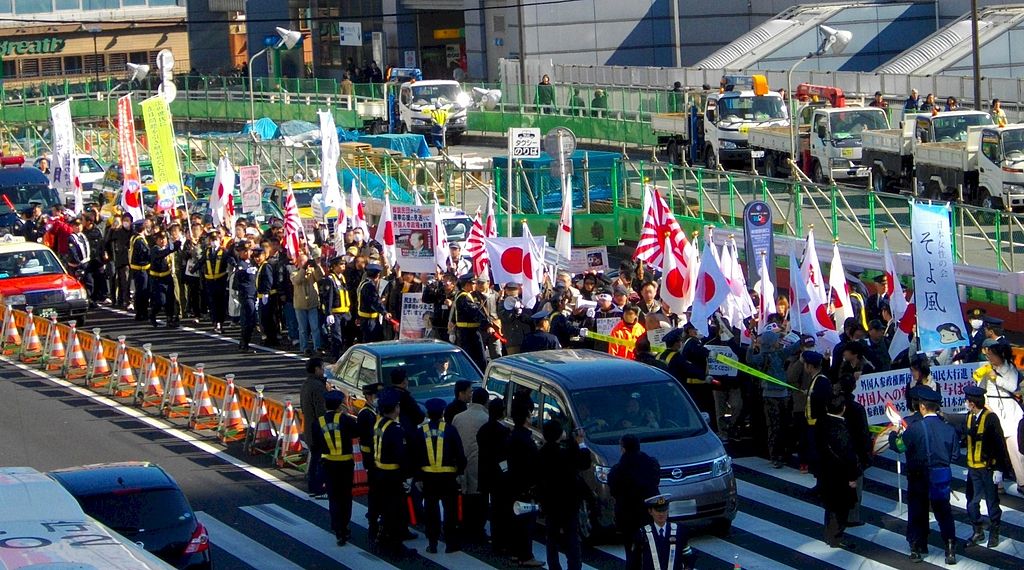
The saga began two weeks ago, when a small group of foreign residents in a modest neighborhood of Osaka engaged in a loud, late-night prayer gathering on a public sidewalk after their rented community space was temporarily locked. Neighbors called the police. Officers arrived, asked the group to disperse, and issued a verbal warning for violating noise ordinances. No arrests. No deportations.
But within 48 hours, that local incident had been transformed. A fringe social media account with fewer than 2,000 followers posted a video of the gathering with an overlay text declaring: “Sharia enforcement patrol in Japan. Locals terrified.” The post was shared 200,000 times within a day.
From there, the story mutated. New videos, unconnected to the original event, were stitched together. A clip of a separate demonstration in London was mislabeled as Tokyo. A photo of an unrelated deportation flight from 2019 was recirculated as “Muslims being sent home.”
“The speed and scale of the distortion is something we have never seen directed at a single community in Japan,” said Kenji Watanabe, a professor of media studies at the University of Tokyo. “The headline became the story, and the story became a verdict—all without a single piece of verified evidence.”

The “sent them home” component of the viral claim appears to reference Japan’s highly restrictive immigration policies, which have long been a source of both domestic support and international criticism. Japan deports roughly 4,000 people annually for visa overstays and criminal activity. There is no record of any deportation linked to the Osaka incident.
Still, the narrative has found fertile ground. Public sentiment polls conducted last week, before the story was debunked by several fact-checking organizations, showed that 34 percent of Japanese respondents believed the claim was “probably true.”
That statistic alarms civil rights advocates who warn that Japan’s small but growing Muslim population—estimated at roughly 200,000 people in a nation of 125 million—has become an easy target.
“Our community is exhausted,” said Rana al-Hussain, a representative of the Japan Muslim Association. “We go to work, we raise our children, we follow the same laws as everyone else. And yet a single fabricated headline can undo years of quiet coexistence.”
The Japanese government has struggled to respond. Chief Cabinet Secretary Yoshimasa Hayashi issued a measured statement calling the videos “misleading” and reaffirming that “Japan has no tolerance for religious enforcement by any group.” But officials have declined to punish the original purveyors of the falsehood, citing free speech protections.

Analysts say the incident reflects a deeper truth about modern information warfare: a believable headline, paired with a grain of real anxiety, can outperform a thousand corrections.
“Nobody shares the retraction,” Ms. al-Hussain said. “But everyone shares the fear.”
As of Tuesday, most of the viral videos had been flagged by Meta and X as unverified or false. But the damage lingers. In Osaka, the men involved in the original prayer gathering have gone into hiding after receiving online threats. Local mosque attendance has dropped by half.
The true story—a noise complaint, a peaceful resolution, and a nation still fiercely protective of its cultural boundaries—has been lost. What remains is a warning: in a world hungry for villains, a headline can be weaponized faster than the truth can pack its bags.


