

LEEDS — The morning sun over Leeds City Square usually illuminates a bustling scene of commuters emerging from the train station and tourists admiring the Victorian grandeur of the Queen’s Hotel. But on Saturday, the square was transformed into a tactical battleground. What began as a scheduled rally for UKIP supporters quickly devolved into a high-stakes confrontation as hundreds of masked counter-protesters—identified by observers as Antifa activists—clashed with police in an attempt to shut down the event. By late afternoon, the air was thick with the scent of smoke and the sound of sirens, as West Yorkshire Police launched a massive arrest operation that has left the city reeling.
The footage from the scene captures a stark escalation in British political protest. Unlike the spontaneous demonstrations of years past, the counter-protest appeared highly disciplined and prepared for legal fallout. “Bust cards” and legal observers were visible on the fringes, a clear indicator that the group arrived expecting arrests. As UKIP’s Nick Tenon attempted to deliver a speech centered on the party’s “No Justice, No Peace” campaign—touching on issues from veterans’ rights to the protection of children—the square erupted into a cacophony of sirens and screams designed to drown him out.
The Invocation of Section 60AA
The turning point of the day occurred when police commanders, citing a rapid decline in public order, invoked Section 60AA of the Criminal Justice and Public Order Act. This specific power allows officers to demand the removal of face coverings where they believe they are being used to conceal identity for the purpose of committing a crime. In the chaos of City Square, the masks were no longer viewed as simple pandemic-era precautions or symbols of anonymity; they were characterized by law enforcement as part of a “tactical, intimidating presence” used to breach police lines.
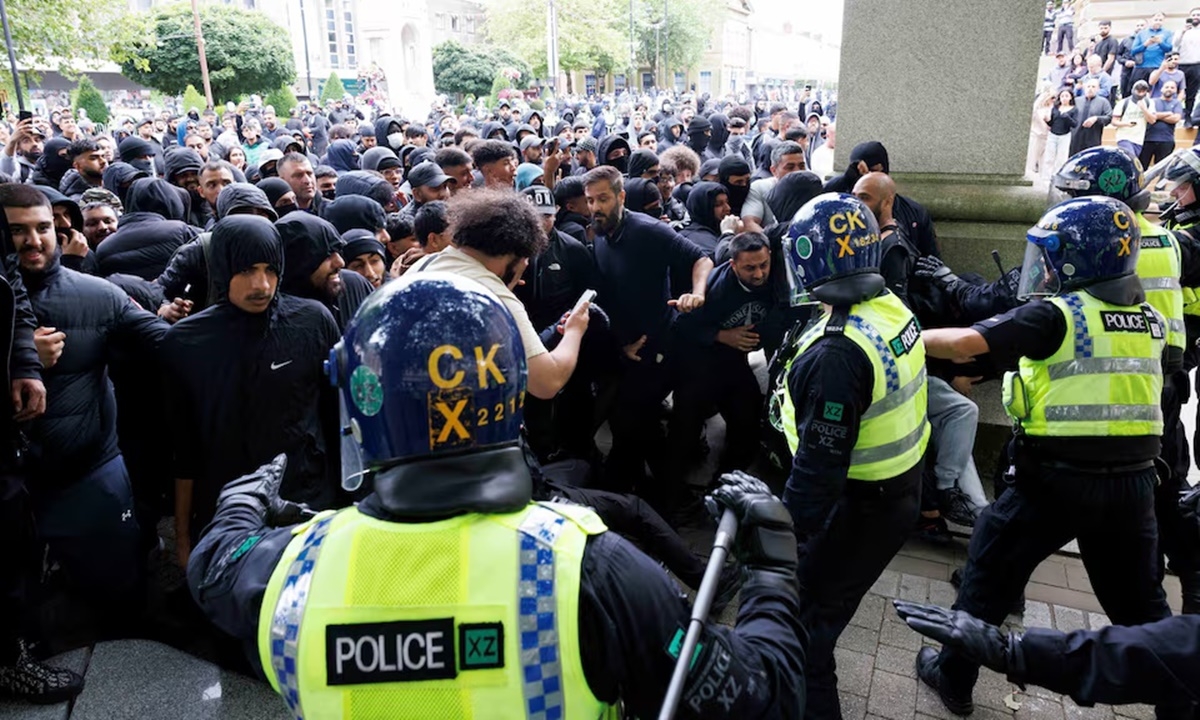
The enforcement of Section 60AA led to immediate friction. Officers were seen moving through the crowd, shouting instructions to “keep moving” and “remove the masks,” as the buffer zone between the two factions began to collapse. When the orders were ignored, the police response shifted from containment to active intervention. The footage shows individuals being pulled from the scrum, cuffed, and escorted to waiting vans—a move that the police described as a necessary measure to prevent a full-scale riot.
The Tactics of Intimidation
For many onlookers, the aggression of the day was a shock. Commentators noted that the counter-protesters didn’t just disagree with the UKIP platform; they appeared committed to a mission of total silence through physical force. “They are very disciplined, very motivated,” noted one witness. This “tactical” approach to protest—marked by the refusal to follow police orders and the physical testing of the police line—has sparked a national debate about where the right to protest ends and the commission of a public order offense begins.
A Call for Power over Justice
Amidst the screaming and the clashes, the rhetoric from the UKIP stage took on a revolutionary tone. Speakers argued that the chaos in the square was proof that traditional “debates” were no longer possible in a divided Britain. “The only way to get justice… is to take power,” one speaker told the crowd, arguing that if the party were in power, the police would “work for you.” It was a stark reminder of how these street-level confrontations are being leveraged into broader political narratives about who truly controls the law and the streets of the United Kingdom.
The Efficiency of the Arrests
Despite the chaos, West Yorkshire Police have been praised for their discipline. Rather than allowing the violence to dictate the terms of the engagement, officers used targeted arrests to “thin out” the most aggressive elements of the counter-protest. This effectiveness prevented the square from becoming a “no-go zone” for the public, even as individuals were being hauled away. The irony of the situation was not lost on observers: a group shouting for “rights” and “freedom” found themselves losing their own liberty in the back of a police van due to their own refusal to comply with the law.
A City Square Divided
As the dust settled on City Square, the physical damage was minimal, but the social divide felt deeper than ever. Leeds is known as a vibrant, fantastic city, yet this incident has left it feeling fractured. When one side of a political debate decides that physical intimidation is the only path to victory, the result isn’t a conversation—it’s a police line. The sight of officers struggling to hold back shouting protesters while tourists watched from the windows of the Queen’s Hotel has become a haunting image of 2026.
The “New Normal” of Disagreement
Is this the new normal for British political expression? The events in Leeds suggest that the barrier between a “protest” and a “riot” is becoming dangerously thin. While a protest is designed to make a voice heard, the attempt to silence another’s voice through force is a direct challenge to the democratic process. When force is introduced into public spaces, the law inevitably steps in, but the resulting arrests and police lines do little to heal the underlying animosity that brought the groups to the square in the first place.
The Legal Fallout
Legal experts expect a long series of court dates to follow the Leeds arrests. The use of Section 60AA is likely to be challenged by civil liberties groups, who argue that the demand to remove masks interferes with the right to anonymous assembly. However, the police maintain that their primary duty is the prevention of serious disorder. For those arrested, the mission to “shut the event down” has resulted in a criminal record—a high price for a day of street-level activism.
The Impact on Local Discourse
For the people of Leeds, the immediate concern is the loss of their public space to political extremism. The square is meant for everyone, but on Saturday, it belonged to no one but the police and the combatants. This incident shows that the growing divide in political discourse is no longer confined to social media; it has manifested as a physical threat to public safety. If disagreement is handled through force, the future of British debate looks increasingly difficult.
Conclusion: A Fragile Lid on Chaos
The police did their job on Saturday; they kept a lid on what could have been a much worse situation. But the massive arrest operation in Leeds is a warning, not a solution. As Britain moves further into 2026, the question of how to handle radical disagreement without resorting to police vans remains unanswered. The square may be clear now, but the tensions that ignited it remain, waiting for the next spark.


