

LONDON — Chaos briefly engulfed parts of central London on a recent Saturday as a self-styled “Community Watch” group confronted a large political demonstration, turning busy streets into scenes of shouting matches and pushing that police struggled to contain.
The incident, captured in widely circulated videos, featured heated exchanges with slogans including “immigrant scum” and calls for “total remigration.” Organizers on one side described their action as a defense of British communities, while counter-demonstrators condemned it as racist vigilantism. No major injuries were reported, but the clash has heightened concerns about deepening divisions over immigration and national identity.
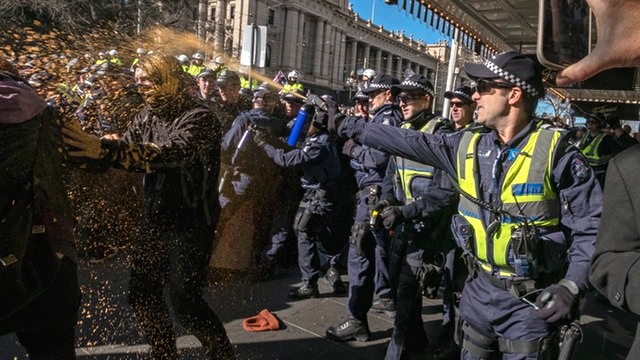
Witnesses described the moment when the two groups came face to face near Whitehall. Members of the Community Watch, many wearing high-visibility vests and carrying banners, blocked part of the route of the larger march. Shouts echoed off government buildings as police formed lines to separate the sides.

The Community Watch presents itself as a grassroots initiative aimed at protecting local neighborhoods from what it calls unchecked migration and rising crime. Its leaders have gained attention on social media platforms by posting footage of street patrols and public speeches.
In one widely shared clip from the event, a speaker addressed the crowd, arguing that Britain’s identity was under threat. The rhetoric quickly escalated, with some participants chanting phrases that critics labeled as inflammatory and dehumanizing.
Police officers, deployed in significant numbers, intervened to prevent the situation from escalating further. A Metropolitan Police spokesperson said officers made several arrests for public order offenses but emphasized that the majority of people on both sides eventually dispersed peacefully.
The clash occurred against the backdrop of ongoing national debates about immigration policy. Britain has seen repeated protests in recent years, both in favor of stricter controls and in opposition to what many view as far-right mobilization.
Community Watch leaders claim their group is filling a void left by what they describe as inadequate policing in certain areas. They have spoken openly about plans to expand operations, including the formation of coordinated “security teams” to monitor streets and report incidents directly to authorities or, in some cases, handle them independently.
Critics, including anti-racism organizations and local politicians, argue that such initiatives risk undermining the rule of law and could encourage vigilantism. They point to past incidents where self-appointed patrols have led to confrontations with ethnic minorities or political opponents.
During the recent gathering, one speaker outlined a vision that extended beyond immigration enforcement. He suggested that the group’s long-term goal involved reshaping British society to prioritize those “born and raised in the traditional British way,” a statement that drew strong reactions from the audience, including cheers from supporters and angry rebuttals from nearby counter-protesters.
The remark, which appeared to imply differential treatment based on heritage rather than citizenship, sent ripples through online discussions. Some viewers interpreted it as a veiled threat to established multicultural norms; others saw it as a blunt expression of cultural preservation.
Social media amplified the moment within hours. Hashtags related to “remigration” and “London streets” trended, with users on opposing sides sharing edited videos that highlighted either the aggression of the watch group or the size of the opposing march.
Government officials have so far responded cautiously. A Home Office statement acknowledged rising tensions but reiterated that all public demonstrations must remain within the law. Prime Minister Keir Starmer’s administration has faced pressure from both sides of the immigration debate, with some Labour backbenchers calling for tougher action against far-right groups and others warning against alienating working-class voters concerned about rapid demographic change.
Legal experts note that while freedom of speech protections are strong in Britain, incitement to racial hatred remains a criminal offense. Several watchdog groups have called for investigations into the Community Watch’s funding and organizational structure, questioning whether it operates as a legitimate community initiative or something more coordinated.
The incident also highlights broader challenges facing London, a city long celebrated for its diversity but increasingly strained by housing shortages, pressure on public services and sporadic outbreaks of disorder linked to political polarization.
Community leaders from immigrant backgrounds expressed fear that such confrontations could embolden attacks on mosques, shops or individuals perceived as foreign. “This isn’t about debate anymore,” said one local councilor who asked not to be named for safety reasons. “It feels like an attempt to intimidate people who have every right to be here.”
Supporters of the Community Watch counter that mainstream media and political elites have ignored legitimate grievances. They cite statistics on knife crime, grooming gang scandals from previous years and the strain on the National Health Service as evidence that current policies are unsustainable.
As Britain heads toward future local and national elections, immigration remains a potent issue. Polling consistently shows a majority of the public favors reduced net migration, though views differ sharply on methods and rhetoric.
The emergence of groups like the Community Watch, with talk of building parallel security structures, raises difficult questions about the state’s monopoly on legitimate force. Historians note parallels with earlier periods of social unrest in the UK, though the current context is shaped by digital mobilization and global migration patterns.
For now, central London has returned to its usual rhythm of tourists, commuters and office workers. Yet the videos from that afternoon continue to circulate, serving as a stark reminder of how quickly public spaces can become arenas for competing visions of Britain’s future.
Whether the Community Watch represents a fringe phenomenon or the leading edge of a wider shift in public sentiment remains to be seen. What is clear is that the conversation about identity, belonging and the limits of tolerance has moved from parliamentary chambers into the streets — sometimes with unsettling intensity.


