

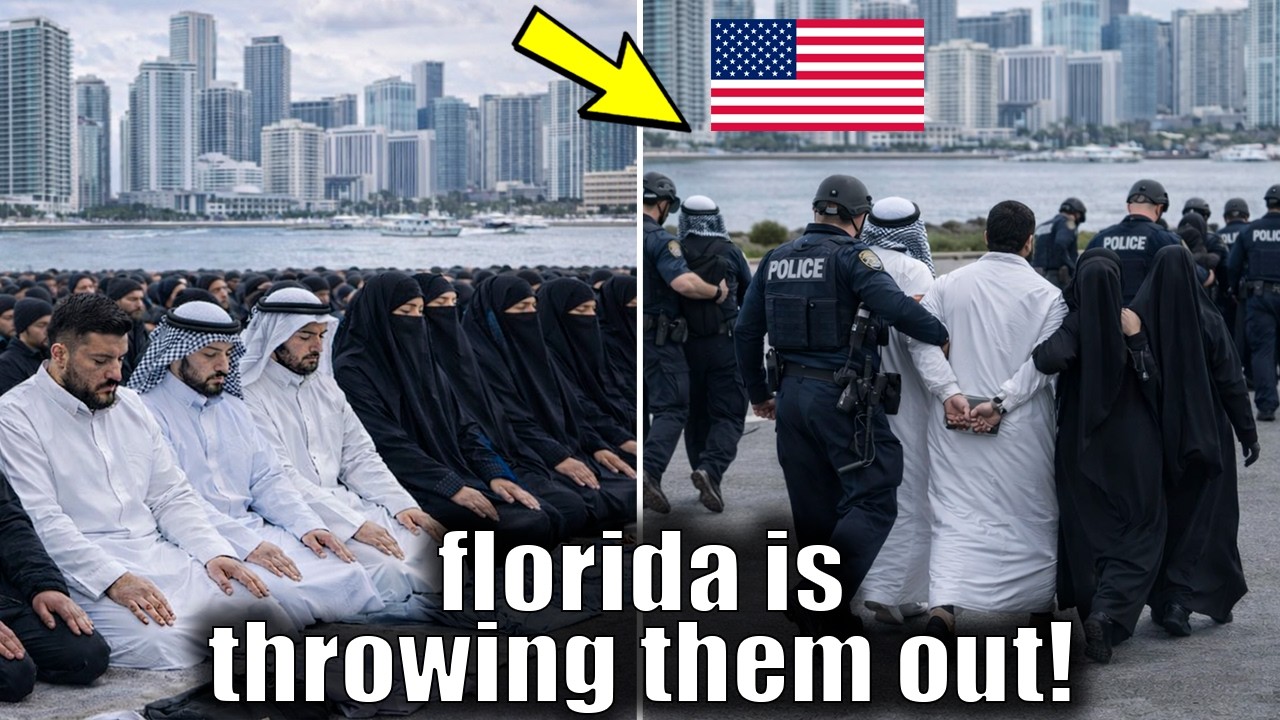
Florida has become the latest flashpoint in a growing national debate over religion, security and the limits of government power, as a series of new state and federal actions have drawn both strong support and sharp criticism.
At the center of the controversy is a sweeping legislative package signed by Governor Ron DeSantis, aimed, according to supporters, at reinforcing “legal clarity” and “public safety.” Critics, however, argue the measures risk targeting a specific religious community and fueling social division.

The legislation includes provisions restricting the application of foreign legal frameworks in state courts, a concept often framed in political discourse as “banning Sharia law.” Legal scholars note that U.S. courts already operate strictly under constitutional law, making such measures largely symbolic but politically potent.
Another element of the package addresses marriage laws, including restrictions on first-cousin marriage. Supporters describe this as a public health measure, while opponents question whether it disproportionately stigmatizes certain cultural or religious groups.
These state-level moves coincide with renewed federal attention on international organizations. Former President Donald Trump has indicated support for expanding terrorism-related designations to include additional groups linked, in policy discussions, to the Muslim Brotherhood. Such proposals have circulated in Washington for years but remain legally and diplomatically complex.
Security experts caution that broad designations require clear evidentiary standards and can have unintended consequences. “These decisions affect not just foreign policy but domestic communities,” said one counterterrorism analyst, noting that sweeping classifications can complicate relationships with allies and civic organizations.
Much of the public debate has also centered on demographic and cultural change. Some activists have raised alarms over reports of religious institutions, including mosques and Islamic schools, expanding into repurposed buildings such as former churches. Religious groups of many faiths, however, routinely acquire and convert properties based on community needs.
Muslim advocacy organizations have strongly rejected claims of coordinated political or ideological “takeover,” describing them as conspiracy-driven narratives lacking credible evidence. They point instead to the diverse and decentralized nature of Muslim communities across the United States.

On college campuses, student groups and civil rights organizations have become increasingly vocal. Some conservative commentators accuse these groups of downplaying security concerns, while advocates argue they are defending constitutional protections, including freedom of religion and expression.
The concept of “Hijra,” referenced in some political rhetoric, has also entered the discussion. In Islamic tradition, it refers to the historical migration of the Prophet Muhammad from Mecca to Medina. Scholars emphasize that its modern usage varies widely and caution against broad or alarmist reinterpretations.
Legal experts say the broader issue may ultimately hinge on constitutional boundaries. “The First Amendment provides strong protections for religious practice,” said a constitutional law professor. “Any policy perceived as targeting a specific religion will face intense judicial scrutiny.”

Florida’s actions reflect a wider national trend in which cultural, religious and security concerns are increasingly intertwined in policymaking. Similar legislative efforts have appeared in other states over the past decade, often sparking comparable debates.
Public reaction has been deeply divided. Supporters frame the measures as necessary safeguards in a changing world, while critics warn of overreach and the erosion of pluralism. Polling suggests that attitudes often align with broader political identities.
As legal challenges loom and national attention intensifies, Florida may serve as a test case for how far states can go in regulating issues that sit at the intersection of religion, law and public policy.
For now, the outcome remains uncertain, but the conversation it has sparked shows no sign of quieting.


