

Shabana Mahmood’s Past Protest Footage Raises Serious Questions About Her Suitability as Home Secretary
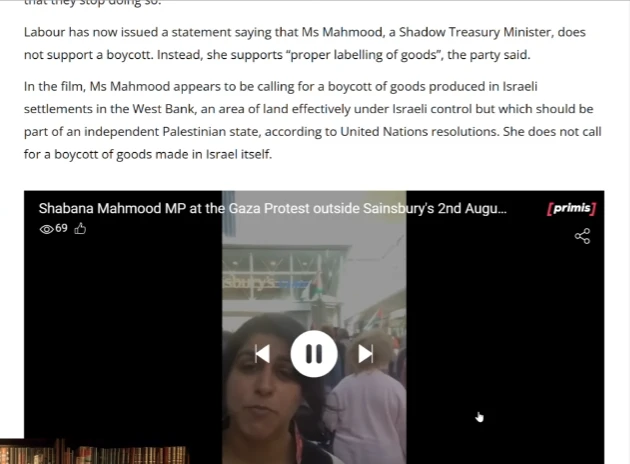
Old video footage of Shabana Mahmood taking part in a pro-Palestine protest outside a Sainsbury’s store in Birmingham has resurfaced online — and the timing could not be more damaging. The clips show her at a demonstration in 2014 that reportedly led to the temporary closure of the supermarket. Years later, she now holds one of the most powerful positions in British politics: Home Secretary, with responsibility for borders, policing, protest laws, national security, and public order.
The question being asked across social media and beyond is straightforward: Can the public trust her to enforce the law fairly and consistently when her own past involves disruptive political activism?
The 2014 Protest
The footage dates back to 2014, when Mahmood joined demonstrators outside a Sainsbury’s in central Birmingham. The protest was directed against the supermarket stocking goods linked to Israeli settlements. Reports at the time described the action as direct action that forced the store to close temporarily, though Sainsbury’s disputed the length of the closure.
In the video, Mahmood can be heard addressing the crowd, encouraging practical steps such as boycotts and lobbying MPs. She spoke about the importance of taking “practical action” to influence government policy on Gaza and Palestine.
While peaceful protest is a fundamental right in Britain, critics argue that a serving MP participating in action that disrupts a legitimate business crosses into different territory — especially when that same person later becomes responsible for maintaining public order.
From Protester to the Person Deciding What Protest Is Allowed
The contrast is what has made the story so explosive. Shabana Mahmood is no longer a backbench MP. As Home Secretary, she oversees how protests are policed, how disruptive demonstrations are handled, and how public order powers are applied across the country.
When old footage shows her associated with direct action that forced a store to close, many people naturally ask whether an ordinary citizen with the same record would be treated with the same understanding by the political and media establishment. The perception of double standards has become impossible to ignore.
This comes at a time when Britain is already deeply divided over issues of protest, policing, and public order. The government has faced legal challenges over restrictions on certain protest groups, and Mahmood herself has been involved in defending Home Office positions on these matters.
Immigration Reforms Under Scrutiny
The controversy is made worse by the fact that Mahmood is currently presenting herself as a tough figure on illegal migration. In recent months, she has announced what the government describes as significant reforms, including extending the qualifying period for settlement and introducing stricter conditions around criminal records, debt, employment, and English language proficiency.
Yet for many members of the public, these announcements feel disconnected from reality. Small boat crossings continue, accommodation pressures remain, and removals are still seen as too slow and ineffective. When old footage of disruptive activism resurfaces, it fuels the belief that politicians operate by different rules to everyone else.
The Real Issue: Trust and Equal Application of the Law
The core argument is not about Mahmood’s personal beliefs or her right to hold political views. It is about whether someone with her history can credibly enforce the law without fear or favour.
Britain has reached a point where large numbers of people no longer believe the rules are applied equally. They see one standard for politicians, activists, and establishment figures, and another for ordinary citizens. When the person now in charge of protest law and public order has a past that raises these questions, trust erodes further.
Mahmood has every right to evolve politically and take on new responsibilities. But with power comes scrutiny. Her past activism is relevant not because of her background, but because of the judgment it reflects — and because she now holds a position that requires the public to believe she will apply the law consistently to everyone.
A Question That Will Not Go Away
The resurfacing of this footage has crystallised a wider frustration. People are tired of what they see as political theater — tough language on borders and order from politicians whose own records suggest a very different set of instincts.
Whether Shabana Mahmood has genuinely changed her approach or simply changed her job title is now a legitimate question the public deserves an answer to. Because in a democracy, the Home Secretary must be able to command public confidence that the law will be enforced fairly — without political bias, without double standards, and without fear or favour.
Right now, that confidence is badly damaged.


